
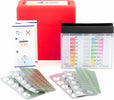
Everything about test kits: how to keep your pool water in perfect balance
, by Rijo Veldhuis, 3 min reading time
, by Rijo Veldhuis, 3 min reading time
Testing your pool water... perhaps not the most fun task, but essential for keeping your water clean and safe. You might be torn between test strips, drops, or a digital tester. Or you might not even know exactly which values to measure – you just want your water to stay blue! No worries, we’ll help you on your way. In this article, you will discover everything about test kits and which one best suits your pool.
A pool tester is indispensable for measuring water quality. Whether you choose test strips, tablets, or a digital tester, they help you maintain the right balance. This is important for clear and hygienic water.
There are different types of testers:
🔹 Manual testers – Test strips and tablets that indicate values through a color change.
🔹 Digital testers – More advanced devices that provide precise measurements.
🔹 Automatic testers – Smart systems that continuously monitor your water quality.
Which tester is right for you depends on your preference for convenience, speed, and accuracy.
✅ Manual testers (test strips and tablets)
These testers work through a chemical reaction with the water, which causes a color change. You then compare the color to a scale to read the value. Advantages? They are affordable and easy to use. Perfect for short seasonal swimmers or quick checks.
✅ Digital testers
These testers collect water, dissolve tablets in it, and provide precise values on a screen. Useful for those who want extra accuracy, especially with intensive pool use.
💡 Our advice: Use manual testers for quick, budget-friendly checks and digital testers for long-term and accurate maintenance.
An automatic tester is like a smart assistant for your pool. This device continuously measures water values and sends the results to your smartphone. No test strips, no hassle, always informed!
📌 Ideal for those who always want control without manual testing.
Chlorine is essential for clean water, but there are two forms:
The difference between these two values indicates whether your pool is being disinfected properly or if there is a buildup of combined chlorine, which can cause irritation.
In a saltwater pool, the salt level is crucial for a well-functioning system. The ideal level is between 2500 and 3000 ppm. Too much or too little salt can interfere with electrolysis and affect your water quality. Not all testers measure salt, so choose a specific salt tester if you use a saltwater system.
✔ Normal use: test twice a week
✔ Lots of sun, many swimmers: test daily
✔ No use (covered): test just before use
✔ Values unregulated? Test several times a day to adjust
Want to know the best order in which to test your water values? Check our comprehensive advice on testing pool water in the right order!